1000 Smart Prompts Toolkit: A Practical Resource for Faster Creative and Business Workflows
Generative AI tools have become everyday collaborators for many professionals. But the quality of output depends heavily on the input—specifically, the prompts you provide. A vague request often yields generic results, while a well-structured prompt can save hours of iteration. The 1000 Smart Prompts Toolkit addresses this directly by offering a structured collection of ready-made prompts across content creation, marketing, business strategy, personal development, and design. Instead of starting from scratch each time, users can pull from a curated library designed to reduce friction and improve output consistency.
What the Toolkit Offers and Why It Matters
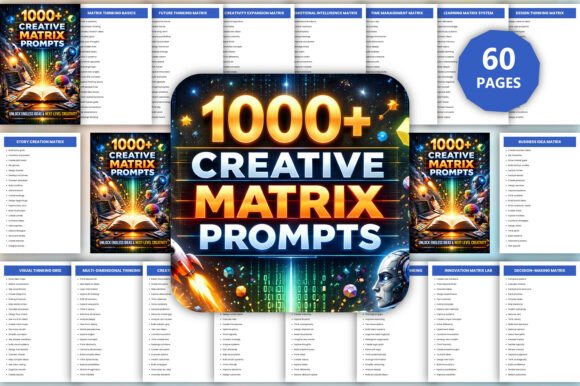
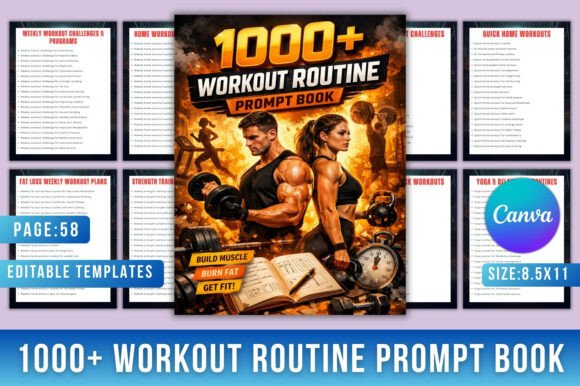
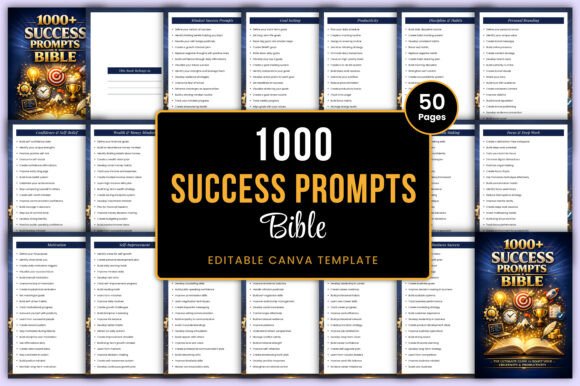
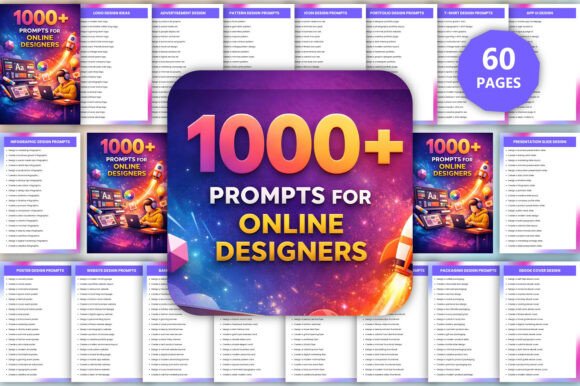
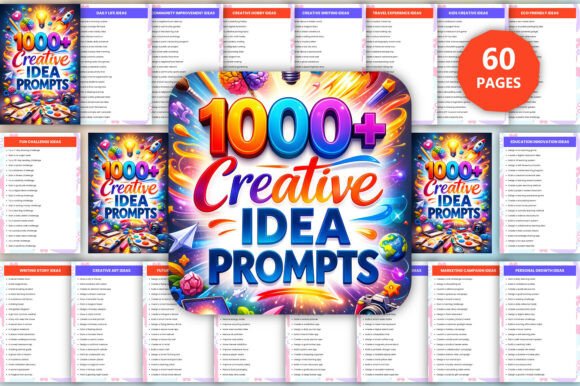
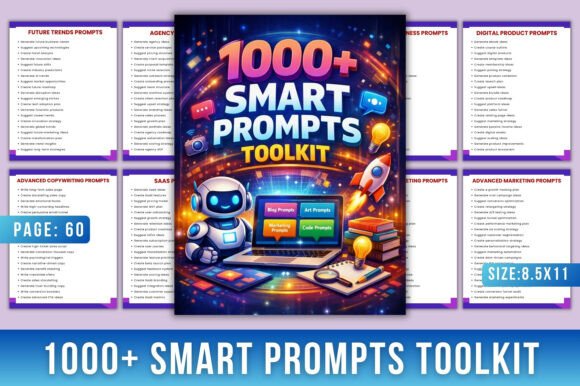
At its core, this toolkit is a 60-page digital planner containing one thousand categorized prompts. It is formatted as a PDF with an 8.5 by 11 inch page size, no bleed, and is ready for upload or printing. The prompts are organized into niche-based sections such as blogging, social media, copywriting, branding, SEO, email marketing, freelancing, e-commerce, UI/UX design, data analysis, goal setting, habit building, and startup strategy. This breadth makes it less of a niche resource and more of a general-purpose accelerator for anyone who regularly works with AI language models, image generators, or analytical tools.
The value proposition is straightforward: eliminate the blank page problem. When you face a tight deadline, a creative block, or a new type of task, having a bank of proven prompts allows you to skip the trial-and-error phase. The toolkit does not claim to teach AI fundamentals—it assumes you already have some familiarity with tools like ChatGPT, Claude, Midjourney, or similar platforms. Instead, it serves as a tactical reference you can open, scan, and adapt.
Breadth and Categorization
The most immediate strength is the range of categories. A content creator might use prompts for blog outlines, video scripts, storytelling hooks, and social media captions all within the same document. A small business owner could jump to sections on email marketing, SEO strategy, and branding without needing to search multiple resources. The categorization is logical and predictable, so finding relevant prompts takes seconds rather than minutes.
Time Savings and Workflow Integration
For professionals who generate content daily—marketers, publishers, educators, and freelancers—the toolkit reduces the cognitive load of prompt engineering. Instead of mentally constructing a prompt for a LinkedIn post, a product description, or a customer research query, you select one, customize it slightly, and run it. Over a week of regular use, this can shave off significant time. The structured format also supports batch processing: you can prepare multiple outputs in one session by working through related prompts sequentially.
Creative Block Mitigation
Creative blocks are not just about inspiration; they are often about not knowing the right question to ask. The toolkit provides a scaffold for thinking. For example, if you are stuck on a brand positioning statement, the prompts guide you through questions about audience, differentiation, tone, and value proposition. This structured approach often reveals angles you might not have considered on your own.
Quality and Consistency of the Prompts
The prompts themselves are written in clear, actionable language. They are not overly complex or academic, which keeps them accessible to users with varying levels of AI experience. Many prompts follow a pattern that includes context, the specific task, and sometimes output formatting cues—this tends to produce more reliable results than shorter or vaguer instructions.
The consistency across categories is notable. A prompt for brainstorming blog topics follows a similar structure to one for generating ad copy, which makes the toolkit feel coherent rather than like a random collection. That said, experienced prompt engineers may find some prompts too prescriptive for their taste. The toolkit favors clarity over open-ended exploration, which is a trade-off that suits efficiency-focused users better than those who prefer highly experimental prompting.
Flexibility and Adaptability
One practical consideration is how well the prompts transfer across different AI platforms. Because the prompts are mostly language-based and task-oriented, they work with ChatGPT, Claude, Gemini, and similar text models without modification. For visual AI tools like Midjourney or DALL-E, some design and branding prompts may need adjustment to include platform-specific parameters. The toolkit does not claim to be platform-specific, so this is expected, but it is worth noting if your primary use case is image generation rather than text.
The prompts also allow for customization. You can insert your own brand names, audience details, product information, or industry context. This flexibility means the toolkit does not become stale after a few uses. The same prompt can produce different outputs when paired with different context or data.
Who Benefits Most
Given the breadth of categories, the toolkit suits several distinct user groups:
- Content creators and bloggers will find the largest immediate value in the sections for storytelling, social media, video scripts, and editorial planning. The ability to generate multiple content angles quickly supports consistent publishing schedules.
- Marketers and small business owners can use the copywriting, SEO, email marketing, and growth strategy prompts to refine messaging and test campaigns without outsourcing every draft.
- Freelancers and consultants benefit from prompts related to client proposals, case studies, personal branding, and productivity. The toolkit can serve as a backup when client work demands fast turnaround.
- Entrepreneurs and startup founders have access to prompts for business planning, market research, decision analysis, and problem-solving. These sections are practical for early-stage validation and strategic thinking.
- Educators and coaches can adapt prompts for curriculum design, lesson planning, student engagement, and personal development exercises.
- Designers and product professionals may find the UI/UX and creative inspiration prompts useful for ideation sessions and user research framing.
Serious hobbyists—those running side projects, newsletters, or personal brands—also fit well. The toolkit removes the barrier of prompt construction, allowing focus on execution and refinement.
Practical Limitations and Considerations
No single resource can be all things to all users, and this toolkit has a few limitations worth considering. First, because it contains one thousand prompts, some sections are necessarily broad. A user looking for highly specialized prompts—say, for legal writing, medical content, or advanced data science—will find general guidance but not deep domain expertise. The toolkit is designed for breadth, not depth in every category.
Second, the PDF format is static. There is no integration with AI platforms, no search functionality beyond what a PDF reader provides, and no built-in way to track which prompts you have used or how they performed. Users who prefer interactive tools or databases may find the PDF format less convenient than a digital notebook or a dedicated app. However, for those who appreciate offline access, portability, and a clean print layout, the PDF structure is a strength.
Third, the toolkit does not include example outputs or case studies. You get the prompts, but not the results they might generate. This is fine for experienced users who know how to evaluate AI output, but beginners may want some indication of what a good answer looks like. Pairing this toolkit with a basic understanding of prompt iteration and output evaluation is recommended.
Long-Term Value and Sustainability
The toolkit is not a subscription or a dynamic resource, so its value depends on how well it integrates into your workflow over time. For users who adopt it as a reference library, it retains value for months or years because the prompts are grounded in common professional tasks that do not change rapidly. Strategy prompts about goal setting, customer analysis, and problem-solving have a longer shelf life than prompts tied to specific social media features or platform trends.
That said, some prompts may become less effective as AI models evolve. Prompt engineering best practices shift, and what works well with one model version may need adjustment with another. The toolkit provides a solid foundation, but periodic testing and customization are necessary to maintain output quality.
Recommendations for Getting the Most from the Toolkit
To maximize the practical return, consider using the toolkit as a starting point rather than a final script. Read through a category once to understand the range of prompts available, then bookmark or flag the ones most relevant to your recurring tasks. Customize each prompt with your specific context before running it—this is where the real improvement in output happens.
Batch your work sessions by category. If you are planning a week of social media content, open the social media section and work through the prompts in one sitting. This approach reduces context switching and helps you maintain a consistent voice across posts. You can also combine prompts from different categories: use a branding prompt to refine your tone, then use a copywriting prompt to apply that tone to a specific piece of content.
For team environments, the toolkit can serve as a shared resource. Distribute the PDF to team members and ask each person to customize prompts for their area of focus. This creates consistency across outputs while allowing individual adaptation.
Final Assessment
The 1000 Smart Prompts Toolkit is a practical, well-organized resource for professionals who regularly use AI in their work. It delivers on its promise of reducing prompt creation time and providing structured guidance across a wide range of categories. The format is straightforward, the prompts are usable, and the categorization supports efficient navigation. It is not a replacement for prompt engineering skill or domain expertise, but it is a reliable shortcut for common tasks.
For content creators, marketers, freelancers, entrepreneurs, and educators who want to work faster without sacrificing output quality, this toolkit offers clear value. Its limitations—static format, broad coverage, and lack of example outputs—are manageable for users with some prior AI experience. If you find yourself repeatedly writing similar prompts or wasting time on trial and error, having a thousand ready-made options at hand is a practical upgrade to your workflow.