Everyday Science Experiments for Kids: Turning Curiosity into Discovery at Home
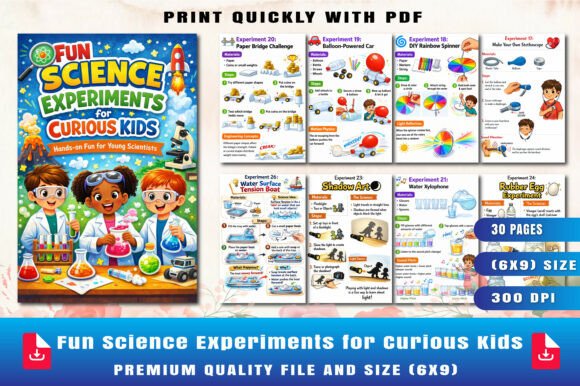
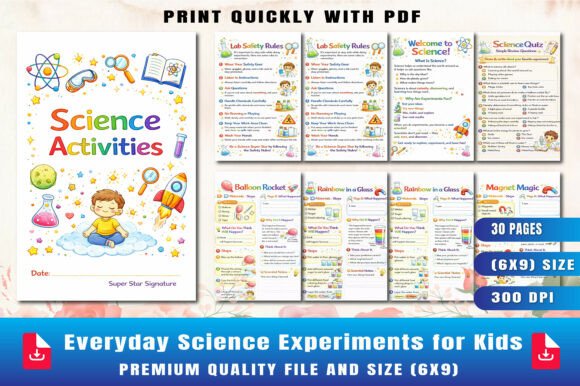
There is a moment that nearly every parent or educator recognizes: the child who stares at a puddle on the driveway and asks where the water goes, or the one who wants to know why a balloon sticks to the wall after a birthday party. These small, everyday questions are the raw material of scientific thinking. Yet for many adults, the instinct is to answer quickly rather than to pause and explore. Everyday Science Experiments for Kids offers a structured, accessible bridge between those spontaneous questions and genuine hands-on learning. This 30-page workbook transforms common household items into gateways for discovery, providing a framework that is as useful for the busy parent as it is for the classroom teacher.
The resource is built around a simple premise: science does not require a laboratory, specialized equipment, or a degree in chemistry. A baking soda volcano, a walking water demonstration, or a balloon rocket experiment can be set up in minutes with items already in the kitchen or craft drawer. Each activity in the workbook follows a clear sequence—materials list, step-by-step instructions, a straightforward science explanation, a reflection section, and guiding questions—so that the adult facilitator does not need to be a science expert to lead the experience. That design choice matters. It removes the intimidation factor that often keeps well-meaning parents from attempting hands-on science at home.
Why Hands-On Science Learning Matters Right Now
The renewed interest in home-based STEM education is not a passing trend. Over the past several years, families have sought alternatives to passive screen time, and educators have looked for ways to make science tangible again. Everyday Science Experiments for Kids arrives at a moment when the demand for practical, low-friction learning resources is high. Parents who are juggling work and household responsibilities still want meaningful activities for their children. Teachers navigating crowded curricula need supplemental materials that are easy to deploy. Homeschool families require resources that align with multiple age levels and learning styles.
What sets this workbook apart is its emphasis on everyday materials. There is no need to order specialty chemicals or wait for delivery of obscure supplies. The floating egg experiment uses salt and water. The invisible ink activity requires lemon juice and a light bulb. The tornado in a bottle works with two plastic bottles and some water. This approach lowers the barrier to entry dramatically. When a child can decide at 3 p.m. to try an experiment and have everything ready by 3:05, the learning happens organically, without the friction of advance planning.
The Evolution of Science Activities for Children
Science education for young learners has shifted noticeably in the last decade. The old model emphasized reading about concepts and memorizing facts. The newer, more effective approach prioritizes observation, questioning, and repetition. The experiments in this workbook reflect that evolution. Each activity is not a one-time demonstration but an invitation to ask further questions. After the rainbow density experiment, a child might wonder what happens if oil is added, or if the order of liquids changes the result. That kind of curiosity is the real goal.
Another evolution is the integration of reflection and documentation. The Science Observation Page included in the workbook encourages children to write or draw what they saw, what surprised them, and what they would do next. This practice builds habits of mind that extend far beyond science. Recording observations, noticing patterns, and revising predictions are skills that transfer to reading comprehension, math reasoning, and even creative writing. The workbook treats science not as a separate subject but as a lens for understanding the world.
The Simple Science Quiz and Certificate of Completion add a layer of motivation that children respond to well. A quiz does not need to be stressful; in this context, it serves as a low-stakes review that reinforces key ideas. The certificate, meanwhile, provides a tangible sense of accomplishment. For a six-year-old who just made a baking soda volcano erupt for the first time, that certificate is a powerful reward.
Practical Implications for Parents and Educators
Adults who use this workbook will notice several practical benefits almost immediately. First, the time commitment per experiment is manageable. Most activities take between fifteen and thirty minutes from setup to cleanup. That fits naturally into an afternoon schedule or a weekend morning without requiring a major time investment. Second, the experiments are designed to work with a wide age range. A four-year-old can participate in the sink or float activity by simply dropping items into water and observing, while a ten-year-old can engage with the deeper explanation of density and buoyancy. That flexibility is valuable for families with multiple children or for classrooms with mixed abilities.
For teachers, the workbook aligns well with STEM program goals. The experiments cover foundational concepts in chemistry, physics, biology, and earth science. The walking water demonstration introduces capillary action. The growing seeds activity touches on botany and the needs of living things. The shadow science experiment explores light and the Earth's rotation. Each experiment can be connected to broader curriculum standards without additional effort. Teachers can use the workbook as a weekly hands-on component or as a resource for science-themed events.
Homeschool families often struggle to find resources that balance structure with flexibility. This workbook provides a clear path forward: twenty experiments that can be done in any order, with materials that are already likely in the home. The print-ready PDF file and high-quality JPG files mean that pages can be printed individually, displayed on a tablet, or even projected in a classroom setting. The 6 x 9 inch page size is portable and easy for small hands to handle.
Realistic Observations About Engaging Young Learners
Not every experiment will work perfectly on the first try, and that is part of the value. When the balloon rocket does not travel as far as expected, or the rainbow density layers mix together instead of separating, the adult has an opportunity to model how real scientists handle unexpected results. The reflection section encourages this exact kind of thinking: what happened, why might it have happened, and what could be changed next time. Children who learn to sit with uncertainty and adjust their approach develop resilience that serves them well in all areas of life.
The workbook acknowledges that adults are not always patient or confident in these moments. The step-by-step instructions are written plainly, with no assumption of prior science knowledge. The easy science explanation section provides the adult with just enough context to answer follow-up questions without needing to research ahead of time. This design respects the adult's time and expertise while still positioning them as a capable guide.
How This Workbook Fits into Modern Learning Lifestyles
Many families are moving away from rigid lesson plans and toward a more fluid, interest-driven approach to learning. This workbook supports that shift. A child might pick it up after school, flip through the colorful kid-friendly design, and decide to try the melting ice challenge because it looks fun. That self-directed choice is powerful. It turns the adult into a facilitator rather than a director, which often leads to deeper engagement and longer retention.
The bright, colorful design of the workbook is not just cosmetic. Visual appeal matters for young learners who are still developing reading stamina. Clear layouts, consistent formatting, and engaging illustrations reduce cognitive load and help children focus on the task rather than struggling to interpret the instructions. The design also makes the workbook feel like a real resource, not a photocopied handout. That perception influences how seriously children take the activities.
Practical Recommendations for Getting Started
For adults who are new to facilitating science experiments, a few simple strategies can make the experience smoother. Begin with an experiment that requires minimal setup, such as the floating egg or sink or float. These activities have few steps and produce clear, visible results. Use the observation page to record what happened, even if the child is not yet writing fluently—drawing counts. Let the child choose the next experiment to maintain momentum and ownership.
If an experiment does not go as planned, resist the urge to fix it immediately. Ask the child what they notice and what they think might be happening. Sometimes the failed attempt is more instructive than the successful one. The workbook's reflection section is designed for exactly these moments. It normalizes the idea that science involves trial, error, and revision.
For classroom use, consider setting up the experiments as stations during a science block. Small groups can rotate through different activities, each with a printed instruction sheet from the workbook. The variety of experiments—from invisible ink to the balloon rocket—ensures that different interests are represented. The Tornado in a Bottle and Shadow Science activities tend to be crowd-pleasers, while Growing Seeds appeals to children who enjoy long-term observation projects.
The Deeper Value of Everyday Science
At its core, Everyday Science Experiments for Kids: Fun, Simple Hands-On Learning at Home is about something larger than any single experiment. It is about creating a household or classroom culture where questions are welcomed, where curiosity is treated as a strength, and where learning feels like an adventure rather than an assignment. The workbook provides the structure, but the real magic happens when a child looks at a common object and sees possibility. A lemon is not just a lemon; it is invisible ink. A plastic bottle is not just trash; it is a tornado in waiting. A piece of string is not just string; it is a bridge for water to walk across.
That shift in perspective is what lasts long after the baking soda volcano has been cleaned up. Children who grow up experimenting, questioning, and reflecting are better equipped to navigate a world that rewards critical thinking and adaptability. They learn that failure is data, that curiosity is a skill, and that the world is full of things worth understanding. For the adults who guide them, the workbook offers a reliable, low-stress way to be part of that journey.
The 30-page format is intentionally manageable. It does not overwhelm with too many options, nor does it skimp on variety. Between the featured experiments, the observation page, the quiz, and the certificate, there is enough material to sustain weeks of regular activity. And because the experiments use everyday items, the learning can continue spontaneously even after the workbook pages are filled. A child who has done the walking water experiment will notice capillary action in a paper towel long after the activity is over. That is the kind of learning that sticks.
For parents, teachers, homeschool families, STEM coordinators, and anyone who works with young learners, this workbook is a practical tool that respects both the child's curiosity and the adult's constraints. It meets families where they are—in the kitchen, the living room, or the classroom—and turns ordinary moments into genuine scientific discovery. The best science experiment is the one that actually happens. This workbook makes that outcome more likely, more enjoyable, and more memorable for everyone involved.