Why a Brain Dump Journal Is the Tool Your Overloaded Mind Has Been Waiting For
In an era defined by constant notifications, endless to-do lists, and the pressure to perform across multiple domains, the mind rarely gets a moment of silence. For professionals, creators, and entrepreneurs alike, the challenge isn't a lack of ideas — it's the sheer volume of them. Thoughts about unfinished projects, lingering worries, creative sparks, and logistical to-dos compete for attention simultaneously, creating a mental fog that slows decision-making and drains energy. This is precisely where the concept of a Brain Dump Journal has emerged as more than a niche productivity tool. It has become a practical response to a widespread cognitive crisis: the need to offload mental clutter in order to think clearly again.
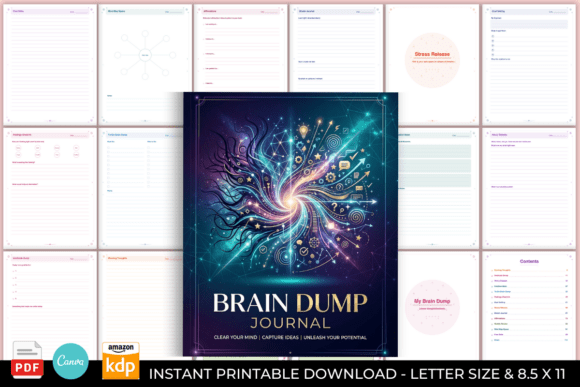
The 🧠 Brain Dump Journal — with its promise to Clear Your Mind, Unleash Your Potential — taps into a growing recognition that the brain is not designed to hold everything. By providing structured space to capture every idea, release every worry, and create space for clarity, this journal meets a real and urgent need for people whose work and life demand constant mental agility. It is not about organizing every thought perfectly from the start. It is about getting thoughts out of your head and onto paper so you can see them, process them, and decide what actually matters.
The Cognitive Load Problem That Modern Work Creates
To understand why a Brain Dump Journal resonates so strongly today, it helps to look at how work and creativity have changed. The boundary between thinking and doing has blurred. Knowledge workers, freelancers, and creators are expected to generate ideas, execute tasks, manage relationships, and adapt to new tools — often simultaneously. This creates what cognitive scientists call cognitive load: the total amount of mental effort being used in working memory. When cognitive load is high, focus fragments, stress rises, and the quality of both thinking and output suffers.
Traditional planners and bullet journals help with scheduling and task management, but they rarely address the underlying noise. A Brain Dump Journal fills a different role. It is a space where nothing is too small, too messy, or too unstructured to write down. Morning anxieties, a sudden creative spark, a worry that keeps circling, a half-formed goal — all of it belongs on the page. By moving this internal dialogue onto paper, the journal reduces the mental burden of holding everything in place. This is not just catharsis; it is a cognitive reset that allows the brain to operate more efficiently afterward.
For entrepreneurs and marketers who juggle multiple projects, this practice can be transformative. Instead of trying to keep track of every idea, deadline, and concern internally, the journal becomes an external brain. The result is not only less stress but also sharper strategic thinking. When the mind is free from holding onto minutiae, it has more capacity to connect dots, spot patterns, and make better decisions.
How the Brain Dump Journal Fits Broader Trends in Productivity and Well-Being
The rise of the Brain Dump Journal aligns with several larger shifts in how people approach work and personal effectiveness. One of the most significant is the move away from rigid productivity systems toward more flexible, human-centered methods. The era of forcing every task into a predefined category is giving way to practices that honor the messy, nonlinear nature of real thinking. Writers, designers, and developers have long used freewriting and stream-of-consciousness techniques to unlock ideas. Now, that same principle is being applied to everyday mental management.
Another trend is the growing awareness of mental hygiene as a daily practice. Just as people have learned to prioritize sleep, exercise, and nutrition for physical health, there is now a parallel emphasis on clearing mental debris regularly. The Brain Dump Journal supports this by offering dedicated sections for morning thoughts, worry release, and feelings check-ins. These are not abstract self-care concepts; they are structured exercises that help users process emotions and stressors before those feelings accumulate into overwhelm.
There is also a notable convergence between productivity and emotional intelligence in the professional world. Leaders and team members alike are recognizing that unaddressed emotions and unchecked mental clutter directly impact performance. A marketer who cannot focus because of lingering anxiety about a campaign, or a creator who cannot generate new work because their mind is full of unfinished tasks, is operating at a fraction of their potential. The Brain Dump Journal provides a low-friction way to address this — not by forcing positivity, but by allowing honest expression and then moving on.
Why Emotional Offloading Matters as Much as Task Management
One of the most compelling aspects of the Brain Dump Journal is that it gives equal weight to emotional content and productivity content. Many professionals have been conditioned to separate their feelings from their work, treating emotions as distractions rather than data. But in practice, emotions are often the hidden drivers behind procrastination, indecision, and burnout. By including a dedicated Worry Release section and a Feelings Check-In, the journal validates the idea that emotional clarity is a prerequisite for effective action.
Consider a freelancer who wakes up feeling anxious about an upcoming client presentation. Without a place to put that anxiety, it will color every other thought and task throughout the day. With a Brain Dump Journal, that freelancer can externalize the worry in a few minutes — writing down exactly what feels threatening, what the worst-case scenario might be, and what is actually within their control. The act of writing reduces the emotional charge, making it easier to approach the presentation with a clearer mind. This is not therapy; it is a practical cognitive technique that anyone can use.
Similarly, the Dream Journal section addresses a often overlooked source of insight. Dreams are not random noise; they reflect subconscious processing of experiences, concerns, and creative material. By capturing dreams immediately upon waking, users can access imagery and themes that might otherwise be lost. For creators and entrepreneurs, this can be a rich source of inspiration and self-awareness. It also reinforces the journal's broader purpose: to create a complete picture of what is happening inside your mind, so you can work with it intentionally.
From Overwhelm to Strategic Clarity: Practical Examples
The value of the Brain Dump Journal becomes most apparent in real-world scenarios. Take the example of a product manager who is juggling stakeholder feedback, technical constraints, and a tight launch timeline. The typical response is to try to keep everything in order mentally, which leads to fatigue and oversight. By using the To-Do Brain Dump section — a master list area to dump all tasks, ideas, and concerns without worrying about priority — the product manager clears the mental deck. Only after everything is on paper does sorting and prioritizing begin. This two-step process (dump first, organize second) is far more effective than trying to categorize in real time.
For a writer or content creator, the journal serves as a incubator for ideas. The Morning Thoughts section allows first impressions and fragments to land on the page without judgment. A half-formed concept from the morning can later be revisited and developed into a full article, social media thread, or video script. The journal does not demand polished output; it only asks for honest input. Over time, this practice trains the mind to generate more freely, because it knows there is a safe place to land.
Entrepreneurs, who often carry the weight of the entire business in their heads, benefit from the journal's ability to separate signal from noise. By regularly offloading every concern — cash flow, team dynamics, strategic decisions, customer feedback — they can see which issues are urgent, which are recurring, and which are simply fears without basis. The journal becomes a decision-support tool, not just a diary.
Changing Needs and Expectations in a Fast-Paced World
The relevance of the Brain Dump Journal is tied to changing expectations around productivity and well-being. The old model of "push through and power up" is being replaced by a more sustainable approach that acknowledges the limits of human attention. People are no longer satisfied with tools that just track tasks; they want tools that support mental clarity, reduce friction, and help them stay connected to what matters. The journal delivers on this by offering a structured yet flexible system that adapts to different states of mind.
Another shift is the move toward intentionality in daily life. With so many demands competing for attention, the ability to choose where to focus has become a competitive advantage. The Brain Dump Journal supports intentionality by helping users recognize what is actually occupying their mental space. When you see your thoughts laid out on paper, you can more easily decide which ones deserve action and which ones can be let go. This is a form of cognitive decluttering that directly supports better decision-making.
For professionals who work remotely or in hybrid environments, the journal also serves as a boundary tool. Without the natural separation of a commute or a physical office, work thoughts can bleed into personal time. A brief brain dump at the end of the workday — using the journal to offload unfinished tasks and lingering concerns — can create a psychological closure that makes it easier to disconnect and recharge.
The Larger Context: A Tool for the Age of Information Overload
Looking at the bigger picture, the Brain Dump Journal is part of a broader cultural response to information overload. The same digital environment that gives us instant access to knowledge also bombards us with input. Email, messaging apps, social media, news feeds, and collaboration platforms create a constant stream of stimuli that the human brain was never designed to handle. The journal offers a low-tech counterbalance — a space that is entirely under the user's control, free from algorithms, notifications, and external demands.
This is not a rejection of technology, but a recognition that the mind needs different modes of processing. Digital tools are excellent for storage, search, and collaboration, but they are less effective for emotional processing, creative incubation, and cognitive release. Paper and pen provide a different kind of engagement — one that is slower, more embodied, and more conducive to reflection. The Brain Dump Journal leverages this strength to address a gap that no app has fully closed.
In a world that constantly asks for more attention, more output, and more optimization, the journal makes a different offer: permission to let go. It acknowledges that you cannot think clearly when you are holding onto everything. By creating a dedicated space to release thoughts, worries, and ideas, it helps you reclaim the mental bandwidth needed for the work that truly matters.
Designing Your Practice Around the Journal
Getting the most out of a Brain Dump Journal does not require a rigid routine. Some users will find value in a daily morning practice, using the Emotional Offloading section to start the day with a clean slate. Others will turn to the journal during moments of overwhelm, using the Worry Release pages to process stress in real time. The Productivity Goal Strategy section can be used weekly or monthly to align actions with larger goals. The key is consistency over perfection — showing up to the page regularly, even when it feels messy.
The journal's structure supports this flexibility. It is designed for people with busy brains, which means it does not demand elaborate systems or lengthy sessions. Five minutes of honest writing can be more valuable than an hour of forced organization. Over time, users develop a clearer sense of what their mind needs — whether that is venting, planning, dreaming, or simply observing. The journal becomes a mirror for the mind, reflecting back what is present and helping users decide what to do with it.
Why You Might Be Paying Attention to This Right Now
If you are a professional, creator, or entrepreneur who has felt the weight of an overloaded mind, the Brain Dump Journal addresses a specific pain point that many tools ignore. It does not promise to make you more productive in the narrow sense of checking boxes faster. Instead, it promises to help you think more clearly, feel less overwhelmed, and create space for the ideas and decisions that actually move your work forward. In a culture that often equates busyness with importance, the journal offers a quieter, more sustainable path: one where clarity comes first and action follows naturally.
The attention this tool is receiving reflects a genuine shift in priorities. People are looking for ways to work smarter, not just harder, and they are recognizing that mental clarity is the foundation for everything else. The Brain Dump Journal is not a magic solution, but it is a practical one — rooted in how the mind actually works, designed for the realities of modern life, and built for anyone who has ever wished they could just get everything out of their head and onto paper.
Whether you use it to capture the first thoughts of the morning, release anxieties before bed, or map out a complex project, the journal becomes a steady companion in the pursuit of clarity. And in a world that keeps demanding more, that clarity is not a luxury — it is a necessity.