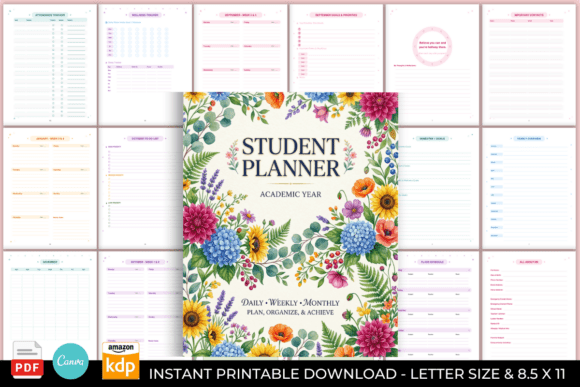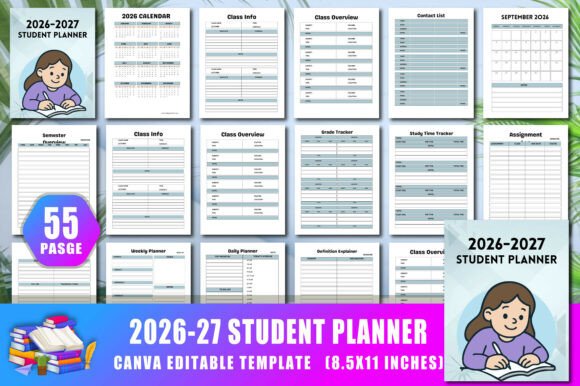
2026-2027 Student Planner: A Real-World Tool for Staying Organized Through Two Academic Years
If you’ve ever found yourself midway through a semester wondering what happened to that assignment deadline or where you jotted down a group project meeting time, you are far from alone. Most planners cover only a single academic year, leaving you to cobble together a new system every January or August. The 2026-2027 Student Planner changes that by giving you a single, continuous framework that runs from early 2026 all the way through the end of 2027. It is built for anyone who needs to track coursework, study sessions, grades, and personal commitments across two full calendar years without starting from scratch halfway through.
This is not just a planner for teenagers in a lecture hall. Adults in their twenties, thirties, and forties—whether they are enrolled in a degree program, taking professional certifications, running a side business, or juggling freelance projects—find themselves in similar scheduling situations. The need to map out assignments, monitor progress, and carve out focused work time is universal. The 2026-2027 Student Planner addresses that need with a structure that feels familiar enough to use immediately but flexible enough to adapt to your specific routine.
Who Actually Uses a Two-Year Student Planner?
It is tempting to assume a student planner is only for high school or college students, but the reality is broader. Many adults are lifelong learners. You might be taking evening classes toward a professional credential, completing a graduate program while working full-time, or self-studying for a certification in project management, data analytics, or a creative field. Others run online businesses and need to track product launches, content deadlines, and client deliverables alongside their personal schedules. The 2026-2027 Student Planner works across these contexts because its core components—assignment logs, grade trackers, study session logs, and project planners—mirror the planning needs of any goal-oriented person.
For example, an entrepreneur launching a course in early 2026 can use the semester overview to map out content creation phases, the assignment log to track each module’s completion, and the grade tracker as a way to measure student feedback or quiz scores. A freelancer handling multiple clients might repurpose the project planner for client work and the homework tracker for administrative tasks. The planner is open-ended enough that you are not locked into a narrow definition of “student.”
Navigating the Overlap Between Two Academic Years
One of the most practical advantages of using a 2026-2027 Student Planner is the way it handles the transition between spring and fall semesters. If you are a college student, the 2026 pages cover your spring, summer, and fall terms, while the 2027 pages continue straight into the next spring. You do not need to re-enter your contact list, birthday tracker, or personal information page. Everything carries forward. That continuity reduces the friction that often causes people to abandon their planning system halfway through the year.
A graduate student I spoke with last year mentioned that switching planners mid-year caused her to miss a grant deadline because she forgot to transfer a single note. With a two-year planner, that risk drops significantly. You only set up your system once, and it stays intact for the entire period.
Keeping Track of Multiple Courses Simultaneously
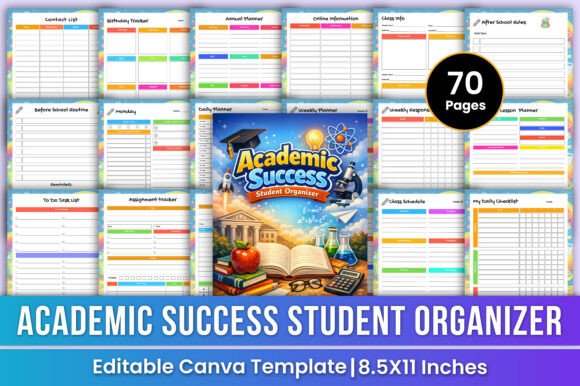
The class overview and semester overview pages let you see all your courses or subjects in one place. If you are taking four classes simultaneously—say, a statistics course, a writing workshop, a marketing certification, and a language course—you can quickly see which ones have overlapping deadlines. The assignment log then becomes your central hub for every due date, submission requirement, and point value. Instead of checking four different syllabi each week, you have a single source of truth.
The project planner and group project pages are especially useful for collaborative work. Real-world group projects often involve coordinating with people who have different schedules and communication styles. The group project page gives you a dedicated space to note each member’s role, deadlines, and meeting notes. That kind of structure can prevent the common frustration of miscommunication or forgotten deliverables.
Tracking Grades and Reading Progress Over Long Periods
The grade tracker allows you to log scores from assignments, quizzes, midterms, and finals across both years. Over time, you can see patterns—maybe your grades dip during certain months or improve when you use a specific study method. The reading log and reading notes pages complement this by helping you track required readings, optional resources, and personal development books. Many adult learners find that keeping a reading log motivates them to stay consistent with non-fiction or industry-related material.
For someone studying for a professional exam, the study session tracker is a game changer. You can log how many hours you studied, what topics you covered, and how focused you felt. After a few weeks, you have data that tells you exactly when and how you learn best. That kind of insight is hard to get from a simple to-do list.
Features That Translate to Real Outcomes
The feature list of the 2026-2027 Student Planner is extensive, but what matters is how each piece helps you save time or reduce mental load. Here are some of the most impactful ones and how they play out in daily use:
- Belongs to Page and Personal Information. This seems basic, but if you ever print multiple copies for different family members or lose your planner in a coffee shop, having a dedicated personal information page with your name, email, and phone number is a simple safety net.
- 2026 and 2027 Calendars with Named Holidays. Knowing when holidays fall matters for planning study breaks, travel, and family commitments. The holiday lists save you from having to look them up separately.
- Contact List and Birthday Tracker. Many users keep these pages even if they only plan to use the academic sections. It makes the planner a more complete life organizer, reducing the need for a second app or journal.
- Monthly Spreads for Each Month. January 2026 through December 2027 are all included. Each month gives you space to write key deadlines, appointments, and personal commitments. You can use them as a high-level view while the daily and weekly pages handle the details.
- Class Overview and Semester Overview. These pages let you see the big picture at the start of each term. You can list course names, instructors, room numbers, office hours, and important dates. This upfront investment pays off every time you need to check a detail quickly.
- Assignment Log, Project Planner, and Group Project Pages. Together these cover individual and collaborative work. The assignment log is ideal for tracking every graded item, while the project planner helps with phased deliverables. Group project pages are tailored for shared responsibility.
- Study Time Tracker and Study Session Logs. These are the pages that turn good intentions into measurable habits. Recording your study time and what you accomplished helps you stay honest and adjust your approach.
- Essay Planner and Definition Explainer. These are lifesavers for anyone writing papers or studying terminology-heavy subjects. The essay planner helps you outline arguments and track drafts, while the definition explainer is perfect for vocabulary in a new field.
- Homework Tracker and Grade Tracker. The homework tracker is your daily task list for assignments, and the grade tracker gives you a running record of your performance. Together, they help you avoid surprises at report card time or before final exams.
- To-Do List, Daily Planner, and Weekly Planner. These provide the granular planning layer. Some people prefer a daily view, others a weekly view. Having both means you can switch based on your workload.
- Course Resources Page. A simple but often overlooked page where you can list textbooks, websites, software, and study groups. Having this in one place saves minutes every week.
What to Consider Before Choosing or Customizing Your Planner
Because the 2026-2027 Student Planner is available as a Canva interior that you can edit, add, or remove elements, you have significant control over the final product. This is especially relevant if you plan to upload it to Amazon KDP as a print-ready PDF or use it for your own personal printing. Before you jump in, consider a few practical factors.
Your planning style matters. Some people prefer writing in tight boxes; others need room to journal. The Canva template allows you to adjust spacing, colors, and shapes. If you tend to write small, you can shrink the boxes and add more rows. If you need larger handwriting space, you can reduce the number of sections per page. Take a few minutes to think about how you actually plan on paper before you finalize the layout.
Think about how you will use the daily and weekly pages. If you are the type of person who thrives on a structured 8-to-6 schedule, make sure the daily planner has enough time slots. If you prefer a looser approach, the weekly planner might be enough. The template gives you both, so you can choose how many of each to include.
Color and design are not just cosmetic. Using high-contrast colors for important sections—like assignment deadlines or exam dates—can make your planner more functional at a glance. If you are preparing this for an Amazon KDP listing, consider that buyers often respond to clean, professional interiors that are easy on the eyes. Avoid overly complex graphics that distract from the content.
Print quality matters for physical use. The template is designed to be print-ready, so make sure you set your margins, bleed, and resolution correctly. If you are uploading to KDP, follow the platform’s specifications to avoid rejected files. A well-formatted planner will lie flat, allow comfortable writing, and hold up to daily use.
Consider how much you want to edit. The beauty of a Canva interior is that you can customize everything. But that also means you can spend hours tweaking fonts and alignment. Decide upfront how much time you want to invest. For many users, the original template is already well-structured and only needs minor adjustments like changing the name on the “Belongs to” page or selecting a different color palette.
A Tool for Building Consistency, Not Just Scheduling
The real value of a planner like this is not that it helps you write down tasks—it is that it helps you build a consistent rhythm. When you see your assignments, grades, study sessions, and reading progress all in one place, you are more likely to notice patterns and adjust before small issues become big problems. The 2026-2027 Student Planner, with its two-year scope and comprehensive features, gives you a framework that supports that kind of reflective planning.
Whether you are a college student trying to stay on top of five classes, a freelancer managing multiple projects, an educator planning a curriculum, or a lifelong learner pursuing a new skill, this planner can adapt to the way you work. It reduces the cognitive load of remembering every deadline and gives you space to focus on the actual work. And because you can edit it in Canva, you are never stuck with a layout that does not fit your needs.
In a world where most planning tools are either too rigid or require constant switching between apps, a well-designed paper planner built for two years offers something rare: stability. You set it up once, use it consistently, and let the structure do the heavy lifting. That is the kind of tool worth making space for.