A Reading Journal for the Real World: How One Notebook Changes the Way You Read
There is a shelf in my living room where books go to be forgotten. I loved them while I was reading them, but a year later I can barely recall the plot, the characters, or even whether I enjoyed the ending. That forgetfulness used to bother me until I started keeping a reading journal. Now, every book I finish leaves a trace, a few sentences that bring the whole experience back. A Reading Journal is not just a notebook. It is a quiet companion that turns reading from a passive act into something you remember, revisit, and build upon.
For adults between twenty and fifty, life is full of competing priorities. We are juggling careers, relationships, side projects, and the constant hum of notifications. Reading often becomes something we squeeze into the margins of the day. A journal does not add pressure. It adds meaning. It gives you a place to land after a chapter, a way to honor the time you spent with a story. And it does so without asking for perfection.
The Reading Challenge Juggernaut Who Needs Accountability
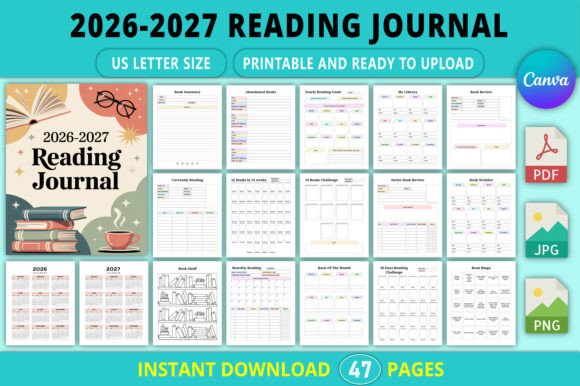
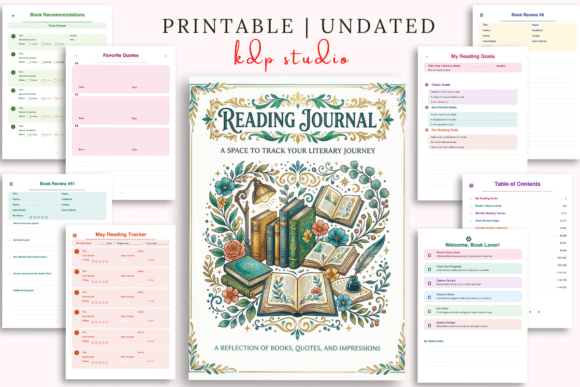
Maybe you set a goal to read fifty books this year. You started strong in January, but by March the momentum faded. Life got busy. You picked up a book, read ten pages, and put it down again. A Reading Journal with a dedicated section for goals and monthly tracking helps you see the pattern without judgment. You flip back to the monthly reading tracker, notice that you only finished two books in February, and realize that had more to do with your schedule than your motivation.
The beauty of the Reading Journal is that it turns data into a gentle nudge. When you see a blank space on the tracker, you are not failing. You are simply seeing an opportunity to pick up a book again. The goals section lets you define what success looks like on your own terms. Maybe success is finishing one book per month while also reading aloud to your child every night. Maybe it is exploring a genre you usually avoid. The journal holds space for that flexibility. It does not judge you for reading slowly. It celebrates the fact that you are reading at all.
The Book Club Member Who Forgets Everything by Discussion Night
Book club conversations can be humbling. You read the same pages as everyone else, but when it is your turn to speak, the details vanish. You remember the cover. You remember whether you liked it. But the names slip away, and the subplot that everyone is talking about sounds vaguely familiar at best. A Reading Journal changes that dynamic entirely.
With the comprehensive book review pages, you can jot down impressions while they are fresh. You note the title, the author, the genre, the dates you started and finished. You give it a star rating, but more importantly, you write a few sentences about how it made you feel. You capture a scene that stood out, a conversation that lingered. By the time book club arrives, you are not scrambling to remember. You are the person who brings the nuanced observation that sparks the best discussion. The journal does not make you a critic. It makes you a more present reader, and that presence shows when you talk about books with others.
The Student or Lifelong Learner Reading for Growth
If you are reading to learn, whether for a degree, a certification, or personal curiosity, a Reading Journal becomes an extension of your thinking. You are not just absorbing information. You are processing it, questioning it, and connecting it to what you already know. The review pages allow you to summarize key arguments, note passages that challenge your assumptions, and track how your understanding evolves across multiple books on the same topic.
Imagine you are reading three books on behavioral economics in one semester. Without a journal, the insights bleed together. With a journal, you can look back and see exactly where one author disagreed with another, which examples stuck with you, and how your own perspective shifted over time. The Reading Journal functions like a personal library of your intellectual growth. It is not about memorizing. It is about making meaning. And for anyone who reads to build expertise, that distinction matters.
The Busy Professional Who Reads in Snippets
Reading in ten-minute intervals is a reality for many working adults. You read during the commute, over lunch, while waiting for a meeting to start. The problem is that fragmented reading makes it hard to hold a narrative thread. You finish a book, but the experience feels scattered. A reading journal helps you gather those fragments into something whole.
You can use the space to write a quick sentence after each session, capturing where you left off and what you noticed. That small habit creates continuity. When you finally finish the book, you have a trail of impressions that you can assemble into a coherent review. The Reading Journal respects the reality of your schedule. It does not demand hour-long reflection sessions. It works with whatever time you have, even if that is just a few minutes before bed. The act of writing, even briefly, signals to your brain that this book matters. And that signal changes how you remember it.
The Emotional Reader Who Needs a Safe Place to Feel
Some books hit hard. They make you cry, or angry, or deeply unsettled. You finish them and do not know what to do with all that feeling. A Reading Journal offers a private space to process. You can write things there that you would never post on social media or say out loud. You can be raw, honest, and unfinished. The journal does not need your thoughts to be polished. It only needs them to be real.
This is especially valuable for adults navigating difficult seasons. A book about grief, addiction, or heartbreak can feel like a mirror. Writing about it in a journal helps you separate your own story from the story you just read. It clarifies what belongs to you and what belongs to the author. The Reading Journal becomes a container for that emotional overflow. It protects you from carrying it around in your head all day. And it gives you a place to return when you need to remember that you made it through that feeling once before.
The Genre Hopper and the Series Devotee
Not everyone reads the same way. Some people jump from literary fiction to sci-fi to memoir in a single week. Others read nothing but epic fantasy series and want to track character arcs across twelve books. A Reading Journal works equally well for both.
For the genre hopper, the journal reveals patterns you might not notice otherwise. You look back and realize you read four thrillers in a row, or that you always pick up a romance novel in December. That awareness can help you diversify your reading or lean into what you genuinely enjoy. For the series devotee, the journal functions as a reference tool. You record which book in the series you finished, what happened in the key plot points, and how your opinion of the series evolved over time. When the next book finally comes out, you do not need to reread the entire series. You just flip through your journal.
What to Consider Before Starting a Reading Journal
A Reading Journal is not a taskmaster. It does not require you to write an essay after every book. Some entries might be a single line. Others might be a full page of thoughts. The flexibility is part of the design. If you pressure yourself to fill every page perfectly, the journal becomes a chore. But if you treat it as an invitation, it becomes a pleasure. The 120-page format gives you room to experiment. You might use it for a year, or you might fill it in six months if you read voraciously. There is no right pace.
One limitation worth noting is that a physical journal requires you to have it nearby. If you do most of your reading on a tablet or phone, you might forget to transfer your thoughts into the notebook. Some people solve this by keeping the journal on their nightstand and writing before sleep. Others carry it in their bag. The key is to find a rhythm that feels natural rather than forced. You do not need to log every single book you have ever read. Start with the ones that matter most, and the habit will grow from there.
Why a Dedicated Journal Outshines a Spreadsheet or App
Digital tools have their place. Spreadsheets can sort your data. Apps can track your stats. But they rarely capture the texture of your reading experience. A Reading Journal is tactile. You write by hand, which studies show helps with memory and emotional processing. You can doodle in the margins, underline your favorite quotes, and add stickers or pressed flowers if that is your style. The journal does not auto-delete your data. It does not distract you with notifications. It sits quietly on your shelf, waiting for you to return.
There is also a durability that digital files lack. A phone dies. An app gets discontinued. A notebook stays. Years from now, you can hand your Reading Journal to a friend or pass it along to a younger reader in your life. It becomes a record not just of what you read, but of who you were during that season of your life. That kind of permanence is rare, and it matters.
Making the Journal Work for Your Actual Life
The best way to use a Reading Journal is to ignore the rules. You are not obligated to fill every field on every page. If you hate rating books with stars, skip it. If you prefer to write in bullet points instead of paragraphs, do that. The journal is a tool, not a test. The whole point is to capture something true about your reading life, not to produce a perfect record.
Some users find that the monthly reading tracker alone is worth the purchase. It gives them a visual sense of progress without judgment. Others love the TBR pages because they turn "I should read that someday" into a concrete plan. And the dedicated review pages, sixty of them, offer enough depth to satisfy even the most reflective reader. Whatever approach you take, the journal meets you where you are. It does not demand consistency. It rewards it, gently and over time.
The real value of a Reading Journal is not in the features or the design. It is in the relationship you build with it. Each page you fill brings you closer to the kind of reader you want to be, not because the journal changes you, but because it reflects what you already care about. It reminds you that reading is not just a hobby. It is a way of living attentively. And that attention, once captured on paper, becomes something you can return to for the rest of your life.