ADHD Productivity Planner for Women Guide
Standard planners assume you have a neurotypical brain. For a woman with ADHD, a long to-do list can feel less like a helpful tool and more like an indictment of her scattered energy. An ADHD Productivity Planner for Women flips the script. It functions as a personal operating manual for your unique brain wiring, built on the premise that productivity does not require perfection. Instead, it requires a system flexible enough to catch you on good days and bad days.
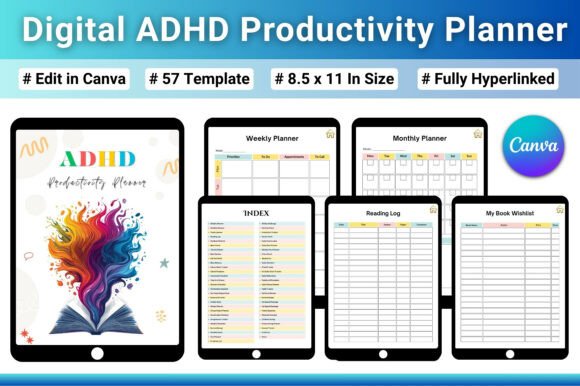
This 30-page printable is designed for women who are tired of complicated planning methods. It acknowledges that your energy fluctuates, your focus wanders, and your best ideas often come out of nowhere. Whether you struggle with task initiation, chronic overwhelm, or simply remembering what you planned to do this morning, this planner offers structure without the shame. It bridges the gap between wanting to be organized and the executive function challenges that come with ADHD.
What Makes a Planner Truly ADHD-Friendly
For beginners or women who have never found a planner that sticks, the core question is simple: why would this one be different? The answer lies in its specific frameworks. An ADHD Productivity Planner for Women does not just list dates and lines. It includes tools designed to work with your brain instead of against it.
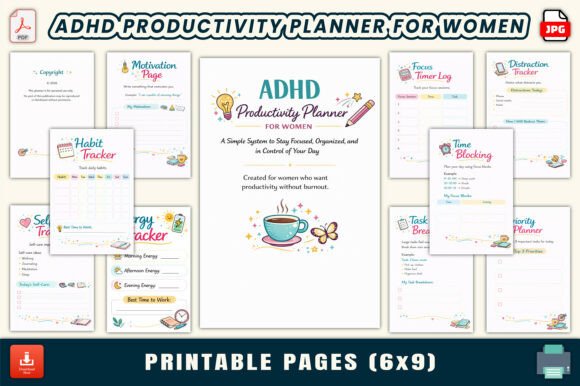
For example, the Brain Dump pages function as an external hard drive for your working memory. When your head is spinning with thoughts, you get them out of your mind and onto paper so you can actually see what is happening. The Energy Tracker validates that your capacity fluctuates. You are not lazy; you are human, and your energy has a natural rhythm. The Task Breakdown Worksheets teach you how to eat an elephant one tiny, ridiculously small bite at a time. Instead of writing “clean garage,” you break it down into “open garage door,” “pick up 5 items,” and “take one bag to the car.”
Traditional planning often triggers shame when tasks spill over. This planner uses a Quick Wins page to build dopamine momentum early in the day. It asks you to identify the easiest, most satisfying task you can finish in under ten minutes. Crossing that off gives you the fuel to tackle something harder. For a beginner, this reduces the barrier to entry. You are not committing to a perfect day; you are committing to a single useful moment.
The Professional’s Edge: From Overwhelm to Output
Entrepreneurs, freelancers, marketers, and corporate professionals face a specific challenge. Many women in high-pressure roles use masking to appear organized. They show up to meetings prepared, but the internal chaos is exhausting. This planner gives you a private, safe space to be messy.
The Time Blocking Planner is not rigid. It allows for overflow blocks and transition time. A freelancer might schedule a two-hour writing block but includes a fifteen-minute “doom-scroll buffer” because she knows she needs a mental break. The Distraction Tracker becomes a data-gathering tool rather than a punishment log. When you track that you always check social media at 3:00 PM, you can plan a quick walk or a snack for that time instead of fighting your own brain.
A professional might use the Focus Session Log to bill clients accurately or to realize that she does her best creative work early in the morning. A marketer could use the Midday Reset page to pivot when a campaign is not performing well, rather than forcing herself to stick to a plan that is failing. The long-term value here is building self-awareness. When you understand your own productivity patterns, you can set boundaries, delegate more effectively, and reduce the risk of burnout. This planner helps you stop fighting your brain and start directing it with intention.
Creative Flow and Home Management
For hobbyists, creators, and home managers, creativity and household management both suffer under strict scheduling. A rigid hourly schedule can kill creative inspiration, while a complete lack of structure leads to messy, unfinished projects. This planner offers a loose structure approach that supports both flow and follow-through.
You can use the Brain Dump pages to capture project ideas, then use the Daily Priority Planner to gently guide your day without strict time pressure. A home manager might use the Habit Tracker for simple family chores like “run dishwasher” or “pack lunch,” but she balances it with the Self-Care Tracker to ensure she is in the equation too. The Motivation: Your Why page grounds the daily grind in personal meaning. Why is it important to keep the living room tidy? Because you want a calm space to relax at night.
A creative entrepreneur might use the Energy Tracker to notice that she has high creative energy after exercise, so she schedules brainstorming sessions during those windows. She uses the Quick Wins page to handle admin tasks like sending invoices or replying to emails when her creative energy is low. The flexibility of this system allows it to adapt to your life rather than forcing your life into a calendar grid. For a busy mom or a side-hustle creator, this adaptability is more valuable than strict time management.
The Coach’s Toolbox and Educational Value
Educators, therapists, and productivity coaches evaluate tools based on their reliability, learning value, and cost. For a professional recommending tools to clients, this printable planner offers high immediate utility at a low cost. It aligns perfectly with executive function coaching principles.
The planner teaches several core skills. Task breakdown is a fundamental executive function strategy. Prioritization is practiced through the daily priority page. Emotional regulation is supported by the motivation and reflection sections. A therapist might use the Self-Care Tracker with a client who struggles with guilt around rest. The Midday Reset page is an excellent tool for clients learning to pivot when their morning goes off the rails.
From a commercial perspective, the 6x9 inch format is portable and familiar, like a paperback book. This reduces the learning curve for new clients. The clean, minimal design is suitable for both clinical settings and personal use. Coaches appreciate that it teaches sustainable habits rather than relying on short-term willpower. The balance of structured planning pages and open-ended brain dump pages allows clients to stay organized while still feeling a sense of autonomy.
Identifying the Right Fit for Your Needs
Before you choose any productivity system, you need to check if it matches your actual goals, skill level, and lifestyle. An ADHD Productivity Planner for Women is ideal if your primary goal is to build consistent, gentle habits. It is designed for beginners who have failed with bullet journals or rigid daily planners, but it also offers enough depth for experienced users who want a ready-made template without spending hours setting up spreads.
- Skill Level: Beginner to intermediate. If you are brand new to structured planning, the included “How to Use the Planner” guide makes it easy to start. If you are experienced, you can skip the instructions and dive right into the trackers and logs.
- Format Value: Because it is a printable PDF, you can repeat your favorite pages without buying a whole new book. If you love the Brain Dump page, print ten copies. If the Habit Tracker is too small, print it larger. This flexibility is a major practical advantage.
- Priority Assessment: If your main struggle is task initiation or emotional overwhelm, this planner is a strong fit. The Task Breakdown worksheets and Motivation pages directly address these pain points. If you need hyper-vertical scheduling down to fifteen-minute increments, you might supplement it with the Time Blocking page, but the overall system is designed for big-picture structure.
- Long-Term Usefulness: The best ADHD tools are the ones you actually use. Because this planner is forgiving and includes reset pages, you are less likely to abandon it after a missed week. The reflection sections help you learn from your patterns so you can improve over time.
Do not buy a planner because you think you should be organized. Buy this planner because you are ready to work with your brain, not against it. It is not about squeezing yourself into a mold. It is about giving your beautiful, sometimes chaotic, brilliant mind a supportive scaffold. The pages are tools, not tests. There is no perfect way to use them, only your way.
Managing ADHD as a woman often means juggling multiple roles, fluctuating hormones, and high expectations from yourself and others. A planner designed for your neurology removes the guesswork and the guilt. It helps you capture your ideas, prioritize your energy, and celebrate small wins. Whether you use it on your tablet with Apple Notes or print it out with a cheap spiral binding, the structure works as long as you are honest with yourself about your needs. Let this planner be a partner in your productivity journey, not a judge of your performance.