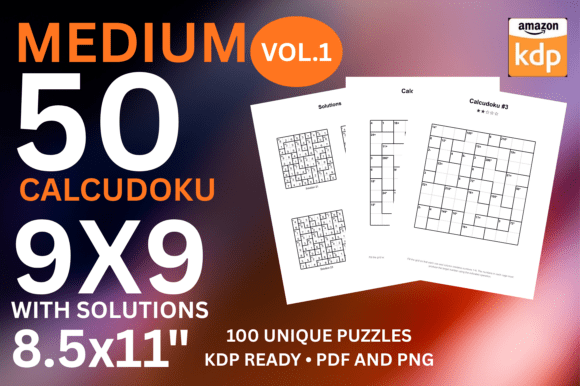
Medium Calcudoku Math Puzzles Vol 1: A Practical Puzzle Collection for Logical Thinkers
Puzzle enthusiasts often seek challenges that reward pattern recognition without relying on guesswork. Medium Calcudoku Math Puzzles Vol 1 delivers exactly that—a thoughtfully assembled set of arithmetic-logic puzzles, also known as Mathdoku, designed to engage the analytical mind. Produced with a custom algorithmic engine and packaged as a ready-to-use digital interior, this collection balances accessibility with genuine depth. For publishers, educators, or puzzle hobbyists looking to expand their offering or sharpen their own skills, understanding what this volume provides—and where its real utility lies—is worth careful examination.
What Makes This Puzzle Collection Distinct
Calcudoku combines the grid discipline of Sudoku with basic arithmetic operations: addition, subtraction, multiplication, and division. The goal is to fill each cell so that every row and column contains each digit exactly once, while also meeting the target numbers inside each outlined cage using the stated operation. Medium Calcudoku Math Puzzles Vol 1 applies this formula with a consistent difficulty level that falls between beginner-friendly puzzles and the more intricate variants found in advanced books.
The volume contains 50 unique puzzles, each generated algorithmically rather than manually curated. That distinction matters because algorithmic generation, when properly validated, ensures every puzzle has exactly one logical solution. No ambiguous paths, no multiple correct answers—just a single clean solving path that rewards careful deduction. Full solutions are included, which adds practical value for self-learners or educators verifying answers.
The interior is delivered as a high-resolution PDF accompanied by individual PNG images. This dual format gives the buyer flexibility: the PDF works for print-ready books or digital distribution, while the PNGs can be used for social media snippets, website previews, or app-based puzzle displays. Dimensions are set at 8.5 x 11 inches with no bleed, which is a standard trade size that fits most print-on-demand platforms without additional trimming or margin adjustments.
Strengths of the Algorithmic Approach
One of the most common frustrations with puzzle collections is repeated patterns or inadvertent duplicate puzzles. The algorithmic testing described for this volume explicitly checks for zero duplicates, which directly addresses that pain point. For a publisher or content creator purchasing an interior, confidence in uniqueness is non-negotiable. A puzzle book that accidentally reuses puzzles under different numbering erodes trust and leads to refunds or negative reviews. This volume's method of generation and verification removes that risk.
The algorithm also enforces a unique logical solution at the point of generation. This is more technically demanding than it sounds. Many puzzle generators either allow brute-force solving (which produces a solution but not necessarily a logical solve path) or generate puzzles that inadvertently contain multiple valid solutions. A single-solution guarantee backed by algorithmic validation means the solver never hits a dead end where they must guess. This quality directly affects the user experience—puzzles feel fair, solvable, and satisfying.
From a production standpoint, the high-resolution PDF format (with no bleed) simplifies importing into layout software or uploading to print platforms. Publishers who have worked with poorly configured interiors will appreciate the absence of alignment issues or resolution loss. The inclusion of PNGs also supports digital-first distribution strategies, such as selling puzzle packs on Gumroad, Etsy, or Teachers Pay Teachers, where individual image files allow buyers to print on demand at home.
Who Benefits Most From This Volume
The medium difficulty level positions this collection squarely at adults who have some familiarity with logic puzzles but are not yet solving expert-level grids. That includes professionals who use puzzles as a mental warm-up, entrepreneurs who want a low-cost add-on product for their store, and educators looking for supplementary materials that exercise arithmetic fluency in a non-repetitive way.
For publishers and small business owners, Medium Calcudoku Math Puzzles Vol 1 functions as a ready-to-publish interior. Because the formatting, puzzle generation, and solution sets are already completed, the main remaining step is adding a cover and uploading to a print-on-demand platform like Amazon KDP or IngramSpark. This reduces turnaround time significantly relative to commissioning a puzzle writer or developing a generation script from scratch.
For educators, the puzzles offer a structured way to reinforce mental arithmetic and logical deduction. The cage operations require students to think about number combinations, inverse operations, and constraints simultaneously. Because numbers may repeat within a cage as long as they are not in the same row or column, the puzzles also subtly teach the concept of conditional repetition—a useful abstraction for learners working with sets and constraints.
For individual puzzle enthusiasts, the 50-puzzle volume provides enough material for roughly one puzzle per day for seven weeks, or a more concentrated session over a weekend. The inclusion of solutions means solvers can check their reasoning when stuck, which supports self-directed learning. The medium difficulty also makes this volume a good candidate for group solving or casual competition among friends or colleagues.
Practical Considerations and Real-World Use
The 8.5 x 11 inch size works well for printing at home or via a commercial printer, but it is larger than a typical trade paperback puzzle book. Buyers who intend to use the PNGs for mobile or tablet solving should note that the image resolution supports clear display on most modern devices, though solving on a phone screen may require zooming on denser puzzles. For digital use, the PDF version is generally more convenient because it preserves the puzzle layout across devices.
A limitation worth noting is that the volume does not include instructional content beyond the basic rules. Newcomers to calcudoku may need to seek external tutorials or sample solves before jumping into the puzzles. For publishers, this means the interior pairs well with a separate guide or a brief introductory page added during the cover design phase. For individual buyers who already understand the rules, the lack of tutorial material is not a drawback—it keeps the book focused on puzzles rather than explanation.
Another point to consider is that 50 puzzles, while sufficient for a low-cost product or a personal supply, may feel thin for buyers expecting a larger collection. Compared to puzzle books that offer 200 or 300 puzzles, this volume is compact. However, the medium difficulty and algorithmic quality partially compensate for the quantity. A smaller set of well-constructed puzzles often delivers more satisfaction than a large set with inconsistent quality or ambiguous solutions.
The dual-format delivery (PDF + PNG) adds versatility, but buyers should verify that the platform where they intend to sell or use the files accepts both formats. Some print-on-demand services require a flattened PDF with no transparency, which the provided file likely meets given the no-bleed specification. For digital marketplaces, PNGs are generally acceptable as long as they are properly compressed to avoid excessive file sizes. The high-resolution nature of the PNGs means they may be large, which could be a consideration for email delivery or low-bandwidth environments.
Long-Term Value and Consistency
A puzzle collection's long-term value depends on whether the puzzles remain engaging after repeated use. Because the algorithm generates each puzzle from scratch rather than reordering a fixed pool, the 50 puzzles here feel distinct. Solvers who complete the volume and enjoy the experience can look for additional volumes in the series or use the format as a reference for building their own puzzle generation workflows.
For publishers, the algorithmic approach also means that future volumes can be produced with the same quality standard without relying on a human constructor's availability or consistency. This scalability is valuable for building a catalog of puzzle books across multiple difficulty levels or operation sets. The volume's professional engineering—meaning the validation logic, formatting, and delivery—reduces the risk of technical issues that can erode customer satisfaction over time.
The inclusion of solutions is another factor that supports long-term use. Solvers who revisit puzzles months later can verify their memory against the official solution paths, and educators who reuse the puzzles across different classes can easily confirm answers without manually solving each grid. The solutions are presented clearly and match the puzzle numbering, so cross-referencing is straightforward.
Who May Find This Less Suitable
Not every audience will find this volume ideal. Advanced puzzle solvers who regularly tackle KenKen or other arithmetic-logic hybrids at high difficulty levels may find the medium rating too easy. The puzzles are designed to be solvable within a reasonable time frame without requiring advanced strategies, which means experts may finish each grid in a few minutes without much challenge. For that group, a volume labeled "hard" or "expert" would be more appropriate.
Similarly, buyers looking for a thick activity book for travel or extended leisure may prefer a collection with more than 50 puzzles. The compact size works well as a supplement or a sample, but it does not replace a comprehensive puzzle library. Publishers considering this interior for a full-size book may want to combine it with additional volumes or supplementary content to reach a higher page count.
Finally, those who prefer puzzles with a narrative or thematic element will not find it here. The content is purely grid-based with no decorative themes, character names, or story framing. This is a strength for users who want a clean, distraction-free puzzle experience, but it may feel bare to buyers expecting a more visually elaborate product.
Final Thoughts on Fit and Practicality
Medium Calcudoku Math Puzzles Vol 1 occupies a specific and useful niche: it is a technically sound, algorithmically validated collection that prioritizes solvability and uniqueness over quantity or flash. For a publisher who needs a reliable interior for a print-on-demand title, an educator seeking supplemental logic puzzles with an arithmetic component, or a puzzle enthusiast who appreciates clean design and fair challenges, this volume offers solid value. The dual-format delivery adds flexibility that is genuinely useful across print and digital contexts, and the no-bleed 8.5 x 11 inch layout fits standard production workflows. While the 50-puzzle count and medium difficulty level limit its appeal for some segments, the quality of the puzzles and the professionalism of the engineering make it a practical choice for anyone who values substance over volume. If your goal is to add a well-made calcudoku option to your store, classroom, or personal collection without reinventing the puzzle-creation process, this volume delivers exactly what it promises.