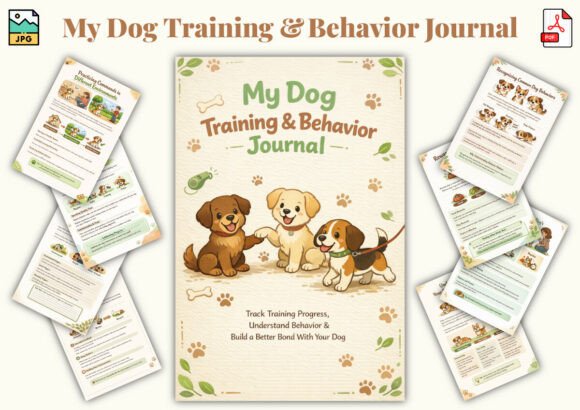
My Dog Training Behavior Journal: A Practical Guide to Tracking Progress and Building a Stronger Bond
Training a dog is not a linear process. It involves consistent practice, observation, and adjustment. Many dog owners start with enthusiasm but lose momentum when progress feels slow or unclear. A structured approach to tracking behavior can make the difference between frustration and steady improvement. My Dog Training Behavior Journal is a tool designed specifically for this purpose. It provides a framework to document training sessions, record behavioral patterns, and reflect on your dog's development over time. Whether you are working with a new puppy or refining advanced behaviors in an adult dog, this journal helps you stay organized, motivated, and informed.
What Is My Dog Training Behavior Journal and Where Does It Fit?
At its core, My Dog Training Behavior Journal is a printable or physical notebook that guides you through the process of tracking your dog's training journey. It includes dedicated pages for goal setting, daily session logs, behavior observations, socialization tracking, reward records, and progress reviews. The journal is not a training method in itself—it is a companion tool that works alongside any training philosophy or technique you choose to follow.
Where this journal fits into a broader workflow is straightforward. It serves as the documentation layer of your training process. Think of it as the bridge between intention and outcome. You decide what to teach, you practice with your dog, and the journal captures what happened, how your dog responded, and what needs to change. This creates a feedback loop that accelerates learning for both you and your dog.
Before Training: Planning and Goal Setting
The journal includes goal planning pages that allow you to define clear, achievable objectives before you begin a session. Instead of walking into a training moment without direction, you can specify what behavior you want to work on, what level of proficiency you aim for, and what rewards or cues you will use. This preparation stage is essential for consistency. When you know exactly what you are working toward, your sessions become more focused and less reactive.
For example, you might set a weekly goal to reinforce "stay" with a five-second duration. You can note the environment you plan to practice in, the distractions present, and the type of reward that motivates your dog most. Writing this down before the session ensures you start with clarity rather than guesswork.
During Training: Real-Time Documentation
The daily training session logs are designed to be used during or immediately after a practice session. You can record the date, duration, specific behaviors practiced, number of repetitions, and how your dog responded. The behavior observation pages encourage you to note body language, energy levels, focus, and any signs of stress or excitement. This real-time capture is valuable because memory fades quickly. A detail you notice during a session—like your dog's hesitation before a command or a sudden distraction that broke focus—can be easily forgotten if not written down.
Using the journal during training also helps you stay methodical. Instead of moving from one exercise to the next without reflection, you pause to note what worked and what didn't. This slows the pace just enough to maintain quality without losing momentum.
After Training: Review and Adjustment
The weekly training progress review pages and challenge reflection pages are where the journal becomes most powerful. After a week of sessions, you can look back at your logs and identify patterns. Maybe your dog responds better in the morning than in the evening. Perhaps a particular command shows progress only when you use a specific treat. Without documentation, these insights remain vague impressions. With the journal, they become actionable data.
The motivation and achievement pages give you a space to acknowledge milestones, no matter how small. Celebrating progress—like your dog holding a "down" for ten seconds for the first time—keeps you engaged and reinforces your commitment. The closing reflection page provides a final opportunity to assess long-term growth and set new directions.
How the Journal Interacts with Other Tools and Methods
My Dog Training Behavior Journal does not replace training expertise, online courses, or professional guidance. Instead, it complements them. If you are following a specific training program—whether it is positive reinforcement, clicker training, or balanced methods—the journal gives you a consistent way to record what you are doing and how your dog is responding. This makes it easier to communicate with a trainer, adjust your approach based on results, or share progress with a partner or family member involved in the training.
The journal also works well alongside digital tools. You might use a video recording app to capture sessions and then transfer key observations into the journal. Or you could combine it with a calendar app to schedule training sessions and then fill in the details by hand. The tactile act of writing may help you remember better than typing alone. Some users prefer to keep the journal as a physical record and also take photos of key pages to store in a digital folder. The workflow is flexible.
For those who train with multiple dogs, the journal can be used for each dog individually. Separate pages allow you to track different behaviors, goals, and progress rates. This avoids confusion and helps you give each dog the specific attention they need.
Start Small and Build Consistency
If you are new to using a training journal, begin with one or two pages. Use the daily training session log for a week before adding goal planning or behavior observation pages. The key is to make the journal a habit, not a chore. Set a reminder to write for five minutes after each session. Over time, the process becomes automatic.
Keep the Journal Accessible
Store the journal near your training area. If you train in your living room, keep it on a shelf or table where you can reach it quickly. The easier it is to grab, the more likely you are to use it consistently. Some owners keep the journal in a tote bag along with treats, clickers, and leashes so that it travels wherever they go.
Use the Socialization Pages Thoughtfully
The socialization tracking sheets are especially useful for puppies or dogs learning to navigate new environments. Record the location, the type of encounter (other dogs, people, sounds, surfaces), and your dog's reaction. Over weeks, you will see which situations are becoming easier and which still need work. This data helps you prioritize exposure activities and avoid overwhelming your dog.
Review Before Each Session
Before you start a new training session, take two minutes to read the previous day's log. This refreshes your memory about what was working and what needs attention. It also helps you maintain continuity between sessions rather than starting from scratch each time.
Involve Family Members or Training Partners
If multiple people are involved in training, designate one person as the primary journal keeper or agree on a shared system. Some families keep the journal in a central location and each person adds notes after their session. This prevents conflicting approaches and ensures everyone is aware of the dog's current level and next steps.
Observations on Long-Term Use and Quality Control
Over several months, the journal becomes a record of your dog's behavioral development. You will notice patterns that would otherwise remain invisible. A dog that seemed to plateau for two weeks may have actually been consolidating previous learning. A sudden regression might coincide with environmental changes or health issues. Having documentation allows you to separate emotional reactions from factual observations.
Quality control in training is not about perfection. It is about consistency. The journal helps you maintain that consistency by giving you a standard format for each session. When you follow the same structure—goal, practice, observation, reflection—you reduce variability in your approach. Your dog benefits from a stable training environment, and you benefit from clearer feedback.
For long-term use, consider reviewing the journal monthly. Flip through the pages and look for overarching themes. Are you seeing progress in the behaviors you prioritized? Are there areas you have been neglecting? The journal will reveal gaps as clearly as it shows successes. Use that information to adjust your focus for the next month.
Who Benefits Most from This Journal?
While any dog owner can use My Dog Training Behavior Journal, it is particularly valuable for people who treat training as an ongoing process rather than a one-time event. This includes professionals such as dog trainers looking for a client-facing tool, educators teaching animal behavior, and pet sitters or walkers who want to document the dogs in their care. It also suits hobbyists who enjoy tracking progress methodically, as well as productivity-minded owners who appreciate structured workflows in all areas of life.
For entrepreneurs and small business owners in the pet industry, the journal can serve as a model for client engagement. Offering a structured journal as part of a training package adds tangible value and helps clients stay accountable. For bloggers and content creators, the journal provides a concrete example of how to systematize a common pain point—dog training chaos—into a manageable routine.
Making the Journal Work for Your Unique Situation
Every dog is different, and every owner has a different schedule. The strength of My Dog Training Behavior Journal lies in its flexibility. You can use all the pages in order, or you can pick and choose the sections that fit your current needs. The reward tracking pages might be essential for a food-motivated dog, while the behavior observation pages become more important for a dog with anxiety. The journal adapts to your priorities rather than forcing you into a rigid format.
If you are working on multiple behaviors simultaneously, use separate pages for each one. If you prefer to focus on one skill at a time, the sequential layout of the journal supports that approach as well. The key is to use the journal as a tool for clarity, not as a test of discipline.
Final Thoughts on Integrating the Journal into Your Training Workflow
Training a dog is a long-term commitment that benefits from organized tracking. My Dog Training Behavior Journal provides the structure needed to turn everyday sessions into measurable progress. By using it before, during, and after training, you create a feedback loop that improves both your dog's learning and your own understanding. The journal works with any method, complements other tools, and scales to fit your specific routine. Start with a single session log, build the habit over a few weeks, and let the journal become a natural part of how you train.
The bond you build with your dog is not just about the commands they learn. It is about the time you spend together, the attention you give to their needs, and the consistency you bring to their development. A journal does not replace that connection—it supports it. When you track progress, you see growth. When you see growth, you stay motivated. And when you stay motivated, your dog thrives alongside you.