The Architecture of Intent: How the Ultimate Fitness Meal Planner Bridges Ambition and Action
Consistency in fitness and nutrition is rarely a failure of knowledge. Most people understand that vegetables are nutritious, that protein supports muscle repair, and that daily movement improves cardiovascular health. The disconnect lives elsewhere—in the gap between knowing what works and actually doing it day after day. That gap is where the Ultimate Fitness Meal Planner operates. It is not merely a collection of grids and checkboxes. It is a behavioral scaffold designed to reduce decision fatigue, externalize memory, and create a feedback loop that turns intention into measurable progress.
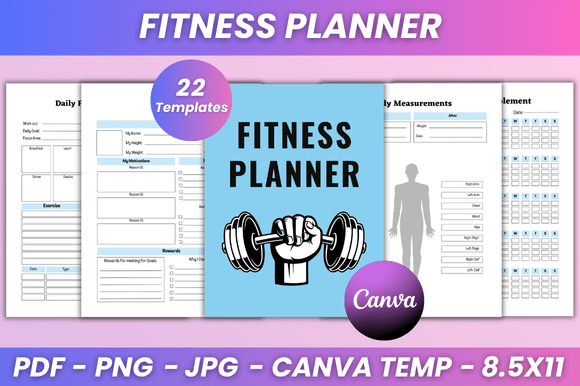
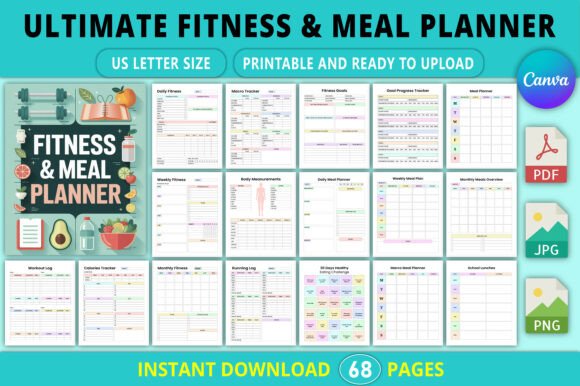
When you open a fully editable Canva version of this planner, you are looking at over fifty distinct tracking and planning tools. Each one addresses a specific friction point that derails even the most determined individuals. The daily fitness log handles the micro-decisions of today. The weekly and monthly views provide the macro perspective needed to spot trends. The workout planner and log ensure that your strength sessions are deliberate rather than improvised. Together, these components form what behavioral scientists call an implementation intention—a concrete plan that specifies when, where, and how an action will occur.
Why Tracking Multiple Dimensions Matters More Than Tracking One
A common mistake in fitness planning is focusing exclusively on one variable—calories, for example, or steps. The Ultimate Fitness Meal Planner takes a different approach by weaving together over a dozen dimensions: calories, macros, water intake, sleep, mood, intermittent fasting windows, strength training volume, cardio sessions, running distance, supplement intake, body measurements, weight, and even period cycles for those who menstruate. This multidimensionality is not clutter. It is ecological validity. Real health is not the product of a single input but the interaction of many.
Consider a week where your weight remains flat but your sleep quality drops, your water intake is low, and your mood tracker shows a downward trend. A single-variable tracker would tell you nothing is changing. The multidimensional planner reveals that you are likely retaining water due to poor sleep and dehydration, masking fat loss that is actually occurring. Without the broader context, you might cut calories further or add more cardio—exactly the wrong response. The planner does not interpret the data for you, but it makes the relationships visible so you can adjust with insight rather than panic.
From a practical standpoint, tracking multiple dimensions also builds what psychologists call self-monitoring efficacy. The more you log, the more attuned you become to the subtle signals your body sends. Over time, you learn that a certain mood pattern precedes a binge episode, or that a particular sleep duration correlates with a better workout the next day. That knowledge becomes your internal compass, and eventually you may need the planner less. But the journey to that internalized wisdom almost always requires external structure first.
The Canva Customization Layer: Why One Size Fits None
Off-the-shelf fitness planners fail for the same reason generic meal plans fail: they ignore individual context. The Ultimate Fitness Meal Planner is delivered as a fully editable Canva template, which means every element—the fonts, colors, titles, layout grids, even the categories themselves—can be reshaped to fit a specific person, client, or brand. For a fitness coach, this means you can rebrand the entire planner with your logo, your signature color palette, and your preferred terminology before sharing it with clients. For an individual user, it means you can remove trackers you do not need, rename sections to match your goals, or translate headers into another language if English is not your primary language.
This editability is especially valuable for KDP (Kindle Direct Publishing) creators and print-on-demand entrepreneurs. A print-ready KDP interior must be polished, consistent, and legally compliant. With a Canva-based template, you can generate a unique product by simply changing the design elements and uploading your customized version. The 60-day weight loss tracker, the 100-mile challenge, the 12-week and 52-week weight trackers—these are not just tools for personal use. They are product modules that can be assembled into a differentiated offering for a niche audience. A runner, for example, might prioritize the running log and running tracker over the strength training pages. A postpartum woman might value the period tracker, sleep tracker, and mood tracker above all else. The template's flexibility ensures that the product can be tailored to these distinct needs without starting from scratch.
From Daily Habits to Transformational Challenges
One of the more striking design choices in this planner is the inclusion of both micro-level daily logs and macro-level challenge trackers. The 30-day challenge, 100-mile challenge, 500-mile challenge, and 60-day weight loss or weight gain trackers serve a different psychological function than a weekly meal planner. They create a narrative arc. Humans are wired to respond to goals that have a clear endpoint and a visible progression. A challenge transforms an abstract aspiration—"I want to get fit"—into a concrete game with rules, a timeline, and a finish line.
Coaches who use this planner with clients report that the challenge pages are often the most engaging. They reduce dropout rates by providing intermediate milestones. A weight loss journey that might take six months can feel overwhelming, but a 60-day tracker breaks it into a manageable sprint. The progress photo pages and transformation tracker add a visual dimension that words cannot capture. When a client sees side-by-side images every 30 days, the subjective feeling of "nothing is changing" is replaced by objective evidence of progress. That shift alone can sustain motivation for another cycle.
For the solo user, the challenge pages double as accountability contracts. If you commit to logging your 100-mile challenge progress, you are implicitly promising yourself that you will not let the chain break. The psychological pressure of a blank space is surprisingly effective. It is the same mechanism that makes habit trackers on paper more powerful than digital ones—the physical act of marking a box creates a cognitive commitment that a tap on a screen does not.
Meal Planning as a Strategic Lever
Nutrition is the most commonly cited barrier to fitness progress, and the Ultimate Fitness Meal Planner dedicates significant real estate to it. The meal planner, daily meal planner, and weekly meal planner pages are not afterthoughts. They are designed to solve a specific problem: the paradox of choice. When you open a refrigerator full of ingredients, the number of possible meals is paralyzing. A meal planner reduces that set to a curated list. You do not decide what to eat at 7 PM when you are hungry and tired. You decided on Sunday, when your executive function was higher and your appetite was not clouding your judgment.
The inclusion of a macro tracker alongside the meal planner is particularly useful for anyone following a specific dietary protocol—whether that is flexible dieting, ketogenic eating, or performance-based nutrition. Tracking macros requires precision, and doing it in a dedicated section of the same planner where you log your workouts means you never have to cross-reference two systems. The information is co-located, which reduces the cognitive load of analysis. When you review a week, you can see immediately whether your carbohydrate intake aligned with your training volume, whether your protein intake supported your recovery, and whether your fat intake was appropriate for your energy needs.
For individuals practicing intermittent fasting, the dedicated intermittent fasting tracker is a subtle but powerful tool. Unlike calorie restriction, intermittent fasting is primarily about timing. The tracker allows you to mark your eating windows and fasting windows, making it easier to maintain consistency. Over time, you may notice patterns—perhaps you feel better with a 16:8 schedule on training days but require a 14:10 schedule on rest days. These insights are difficult to capture without a dedicated tracking space.
The KDP and Creator Ecosystem: Beyond Personal Use
The Ultimate Fitness Meal Planner exists at the intersection of two growing markets: the health and wellness industry and the print-on-demand publishing ecosystem. For creators on KDP, the value proposition is clear. A single template purchase can generate dozens of product variations. You can create a version focused on strength training for men, another focused on weight loss for women, a minimalist version for busy professionals, and a colorful version for teenagers. Each variation requires only a few hours of editing in Canva, but each can be listed as a separate product on Amazon.
The print-ready aspect is critical. KDP interiors must meet exacting specifications for margins, bleed, and resolution. A template that is already optimized for print saves hours of formatting frustration. Moreover, the inclusion of both daily and weekly views means buyers see immediate utility. A potential customer browsing KDP will recognize that this planner covers more ground than most competitors. The 52-week weight tracker alone signals long-term commitment, which appeals to buyers who are tired of fad solutions.
From a content marketing perspective, the planner also serves as a lead magnet or client resource for fitness professionals, nutrition coaches, and wellness bloggers. Offering a customized version of this planner to your email list builds trust and authority. It demonstrates that you are not just giving advice—you are providing tools for implementation. The difference is significant. Advice is passive. A tool is active. When a client uses your branded planner daily, your brand becomes part of their routine.
Practical Considerations for Implementation
Adopting a comprehensive planner of this scope requires some upfront investment. The first week will likely feel slow as you familiarize yourself with the layout and decide which trackers to prioritize. The Ultimate Fitness Meal Planner contains over fifty distinct pages, and using all of them simultaneously is neither necessary nor advisable. A better approach is to start with three or four trackers that address your most pressing needs—perhaps the daily meal planner, the workout log, the water tracker, and the sleep tracker. As those become habitual, you can layer in additional dimensions such as the mood tracker, the macro tracker, or the transformation pages.
Another consideration is portability. If you primarily work out at a gym, you may want to print individual pages or use the planner in a binder format. The Canva template allows you to rearrange pages, so you can group all the workout-related logs together and all the nutrition pages together. For digital users who prefer tablet-based planning, the planner can be used with annotation apps that support PDF import. The flexibility is intentional—the tool should conform to your workflow, not the other way around.
For those using the planner with clients, it is worth noting that the progress photos and transformation pages require sensitivity. Not every client is comfortable with visual tracking, and the decision to use those pages should be collaborative. The planner provides the option, not the obligation. Similarly, the period tracker is only relevant for a subset of users, but its inclusion reflects a growing recognition that hormonal cycles influence training response, appetite, and recovery. Ignoring that dimension would be a gap in any truly comprehensive fitness tool.
The Long Game: Why Paper Planning Still Matters in a Digital Age
It is easy to assume that a smartphone app can replace a printed planner. Apps are convenient, they sync across devices, and they often include algorithmic recommendations. But they also introduce distractions. A notification from your calorie tracker can quickly lead to a detour through social media. Paper has no notifications. It offers what attention researchers call friction-free focus—a space where you are not competing with a thousand other stimuli.
The physical act of writing also engages the brain differently than typing. Studies in cognitive psychology suggest that handwriting improves encoding and retention of information. When you write down your weight, your meals, and your workout sets, you are not just recording data. You are processing it. That processing is where self-awareness grows. Over weeks and months, the planner becomes a personal archive of decisions and outcomes. It tells the story of your effort, not just your results. And that story is what sustains long-term consistency when motivation wanes.
The Ultimate Fitness Meal Planner is not a magic solution. It will not cook your meals, run your miles, or lift your weights. But it will provide the structure within which those actions become repeatable. And repeatable actions are the only path to sustainable change. Whether you are a coach building a client system, a creator building a KDP catalog, or an individual building a healthier life, this planner offers a flexible, editable foundation that respects your uniqueness while holding you accountable to your goals. The gap between ambition and action is not closed by willpower alone. It is closed by architecture. This planner is that architecture, ready to be shaped to your hand.